
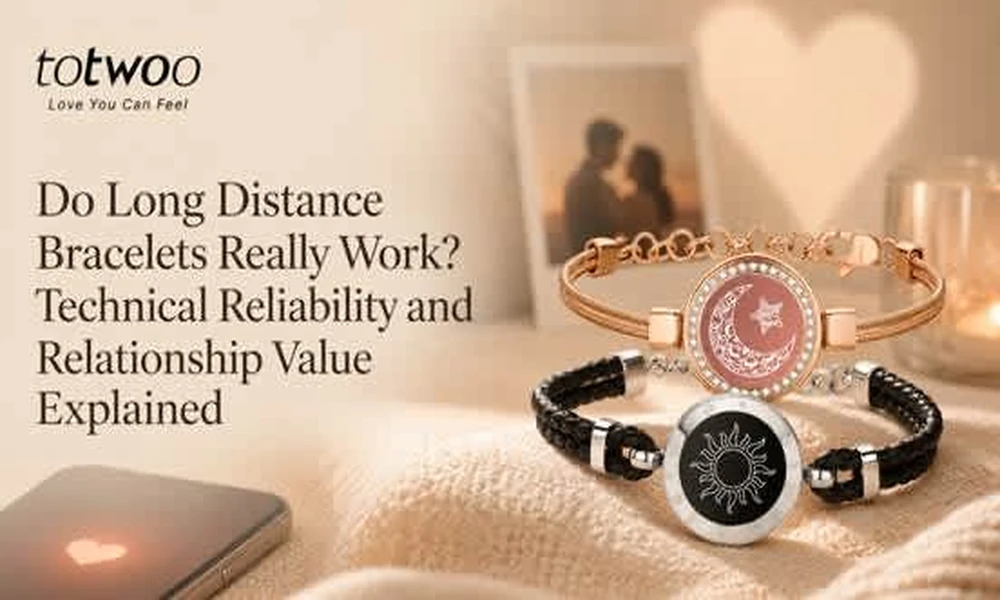
The first is technical: Can the bracelets pair correctly, stay connected, and deliver light or vibration signals reliably?
The second is emotional: Can a small signal from a bracelet genuinely help two people feel closer?
These questions need separate answers. The technology can function as intended without transforming a relationship, while a technically simple signal can still feel meaningful to couples who enjoy using it.
The most accurate conclusion is that long distance bracelets can work well as lightweight communication tools when both partners are willing to wear, charge, connect, and use them regularly.
Does the Technology Work Reliably?
Connected bracelets do not usually communicate directly with each other across hundreds of miles. Each bracelet normally connects to its wearer’s smartphone through Bluetooth, while the phones use the internet to transmit the signal.
The typical process works like this:
One person touches or activates the bracelet.
The bracelet sends the action to its connected phone through Bluetooth.
The supporting app transfers the signal through Wi-Fi or mobile data.
The partner’s phone receives the signal.
The second bracelet responds with light, vibration, or both.
When the devices are charged, the phones are online, and the app has the correct permissions, the experience should feel simple. However, several connection points must work correctly for the signal to arrive.
Pairing and Phone Compatibility
Most touch bracelets for couples need to be paired with compatible smartphones before they can send remote signals.
Both partners may need to:
• Download the same supporting app
• Create or register individual accounts
• Enable Bluetooth
• Pair each bracelet with its owner’s phone
• Connect the two accounts inside the app
• Allow the app to run in the background
Compatibility should be checked before buying. A bracelet that supports current iOS and Android devices may not necessarily work with every older phone, operating system, or regional app-store account.
Some products can only connect to one phone at a time. Changing phones may require the user to disconnect or forget the original Bluetooth device before pairing it again.
Internet and Background App Requirements
Bluetooth only connects the bracelet to the nearby phone. Communication across cities or countries normally requires both phones to have Wi-Fi or mobile-data access.
Background app permissions are equally important. If the operating system closes the app to conserve battery, the bracelet may temporarily stop receiving signals.
After restarting a phone, users may need to reopen the app and confirm that the bracelet has reconnected. Android battery optimization, iPhone Background App Refresh, Low Power Mode, notification permissions, and Bluetooth settings can all affect performance.
This means occasional missed signals do not necessarily indicate that the bracelet is broken. The problem may come from the phone, internet connection, app permissions, or Bluetooth status.
Signal Delay and Connection Stability
A touch signal is not guaranteed to arrive at exactly the same speed every time. Delivery can be affected by:
• Weak Wi-Fi or mobile reception
• A disconnected Bluetooth connection
• The app being closed by the phone
• Temporary server or notification delays
• One bracelet having insufficient battery power
• Incorrect account pairing
Couples should treat the bracelet as a casual emotional signal rather than an emergency communication device. It should not be used for urgent messages, safety alerts, or situations where confirmed delivery is essential.
Battery Life and Charging
Connected light and vibration bracelets require regular charging. Depending on the model and frequency of use, many smart bracelets operate for several days between charges.
Frequent signals, stronger vibration settings, and continuous Bluetooth use may reduce battery life. If either person regularly forgets to charge wearable devices, the experience can quickly become inconsistent.
Charging time, cable type, replacement charger availability, and battery warranty should therefore be checked before purchasing.
Water Resistance and Daily Wear
Water-resistant and waterproof are not always interchangeable terms. A bracelet may tolerate rain, sweat, or accidental splashes without being suitable for showering or swimming.
Buyers should look for a clearly stated water-resistance rating and follow the care instructions for the exact model. If no numerical rating is provided, it is safer not to assume that the bracelet can be submerged.
How Totwoo’s Technology Works
Totwoo bracelets use Bluetooth to connect each piece of jewelry to its owner’s smartphone. Both partners need the Totwoo app and an internet connection to send and receive long-distance signals.
Selected Totwoo models support light and vibration responses. Users can also adjust certain interaction settings through the app, although available functions may differ between designs.
For current models such as the Candy Original, the official specifications list:
• Compatibility with iOS and Android
• Bluetooth 5.0 connectivity
• Approximately three to five days of battery life
• Around one hour for a full charge
• PC, 316L stainless-steel, and silicone materials
• An adjustable inner circumference of approximately 5.52 to 8.46 inches
The product guidance describes protection for ordinary daily exposure but also recommends removing the bracelet before showering. Buyers who want to swim while wearing it should verify the exact model’s water-resistance instructions before purchase.
Technical reliability therefore depends on more than the bracelet itself. Both users need charged devices, compatible phones, active internet access, Bluetooth connectivity, and correctly configured background permissions.
Do Long Distance Bracelets Help a Relationship?
Even when the technology functions correctly, a second question remains: Does receiving a light or vibration actually help two people feel closer?
There is no universal answer. A bracelet cannot guarantee emotional closeness, and marketing claims cannot prove that every couple will find the experience meaningful.
Its value depends on the meaning the couple gives to each signal.
When the Experience Can Feel Meaningful
Long distance touch bracelets may add emotional value when couples use them to create simple shared rituals.
A signal might mean:
• “Good morning”
• “I arrived safely”
• “Good luck with your meeting”
• “I’m thinking about you”
• “Goodnight”
• “Call me when you have time”
For partners with different work schedules or time zones, these gestures can provide connection without demanding an immediate conversation.
Vibration bracelets for couples may be especially useful during work, study, or travel because the signal can be noticed without opening a phone. Light-based responses may appeal more to couples who enjoy a visible and playful interaction.
The technology does not create the emotional meaning. The couple creates it by repeatedly associating the signal with care, reassurance, or a shared routine.
What the Bracelets Cannot Do
Smart couple bracelets cannot:
• Replace honest conversations
• Resolve trust or communication problems
• Guarantee a partner will respond
• Prove where someone is or what they are doing
• Prevent loneliness during a long separation
• Repair a relationship that both people are no longer maintaining
They work best as an additional communication layer rather than a substitute for calls, messages, visits, and emotional openness.
Expecting the bracelet to solve deeper relationship problems will likely lead to disappointment.
Who Is Most Likely to Enjoy Them?
Bracelets for long distance couples may suit:
• Partners who enjoy small, spontaneous signs of affection
• Couples living or studying in different cities
• Partners who travel frequently for work
• Military couples dealing with changing schedules
• People who already enjoy wearable technology
• Couples who want a private signal between conversations
• Partners willing to create meanings for different light or vibration patterns
Shared enthusiasm matters more than the number of features. If only one person wants to use the bracelets, they may soon be left uncharged or unworn.
Who Should Consider a Traditional Bracelet Instead?
Connected bracelets may not be suitable for everyone.
A traditional matching bracelet may be a better choice for people who:
• Do not like downloading or managing apps
• Frequently forget to charge electronic devices
• Regularly turn off Bluetooth or mobile data
• Do not normally wear bracelets
• Prefer jewelry without electronic components
• Want something suitable for swimming or constant water exposure
• Expect the bracelet to solve existing relationship difficulties
Traditional matching bracelets require no phone connection or charging. They provide symbolism without adding another device to maintain.
Neither choice is automatically better. Smart bracelets focus on interaction, while traditional bracelets focus on a lasting physical reminder.
What to Check Before Buying
Before purchasing, couples should confirm:
• Which phones and operating systems are supported
• Whether both users need separate accounts
• Whether the app must remain active in the background
• Whether Wi-Fi or mobile data is required
• The expected battery life and charging time
• Whether replacement charging cables are available
• The stated water-resistance rating
• Bracelet size and adjustability
• Available light, vibration, and customization options
• Current warranty, return, shipping, and support terms
• Whether both partners will realistically wear and maintain the bracelets
Recent model-specific reviews may also help identify recurring issues involving connectivity, comfort, strap security, app performance, or battery life. Reviews should be considered alongside current specifications because software and product designs can change.
So, Do Long Distance Bracelets Really Work?
Technically, they can work when both bracelets are charged, correctly paired, connected to compatible phones, and supported by stable Bluetooth and internet connections. Their reliability is affected by phone permissions, background app activity, network quality, and user habits.
Emotionally, they can create meaningful moments for couples who enjoy lightweight, spontaneous communication. However, they cannot independently improve a relationship or replace deeper forms of connection.
The fairest conclusion is conditional: long distance bracelets can work well as small communication tools when both partners are willing to wear, charge, connect, and use them consistently.